Europe’s goal to defeat Russian aggression could be over before it begins if allies can’t see what’s coming.
Russia’s war on Ukraine has exposed significant gaps in NATO readiness and ability to conduct intelligence, surveillance, and reconnaissance (ISR) activities that enable deterrence. According to a report by the independent, nonpartisan research institute Center for Strategic and Budgetary Assessments (CSBA), Diamond in the Rough: The Past, Present, and Future of NATO’s ISR Force, NATO simply lacks the ability to conduct the persistent airborne ISR necessary to credibly detect or defeat potential Russian threats.
Although this problem isn’t new, it’s become increasingly urgent for nations across Europe to increase defensive preparations in the wake of the Russia-Ukraine conflict.
Fortunately, NATO already has a command that could anchor an upgraded ISR network. The NATO ISR Force (NISRF) currently operates a fleet of uncrewed aircraft from Naval Air Station Sigonella, Sicily, Italy. The installation serves as the NATO hub for the processing, exploitation, and dissemination of data collected by alliance aircraft and other intelligence sources.
But according to CSBA researchers, Travis Sharp and Ryan Kaufman, NISRF needs more uncrewed aircraft systems (UAS), sensing capabilities, personnel, bases, and common intelligence sharing across the alliance.
More Uncrewed Aircraft, Sensors, and People
The small fleet of ISR aircraft and geographic restriction to NAS Sigonella means NISRF can only manage one sortie per week in efforts to cover major hot spots across Europe and the High North.
Additional personnel, increased training, and improved support could generate more missions, the CSBA report states, but there are limitations to the current aircraft fleet. It lacks the capabilities to provide NATO with relevant, responsive, and operational ISR the way the threat demands.
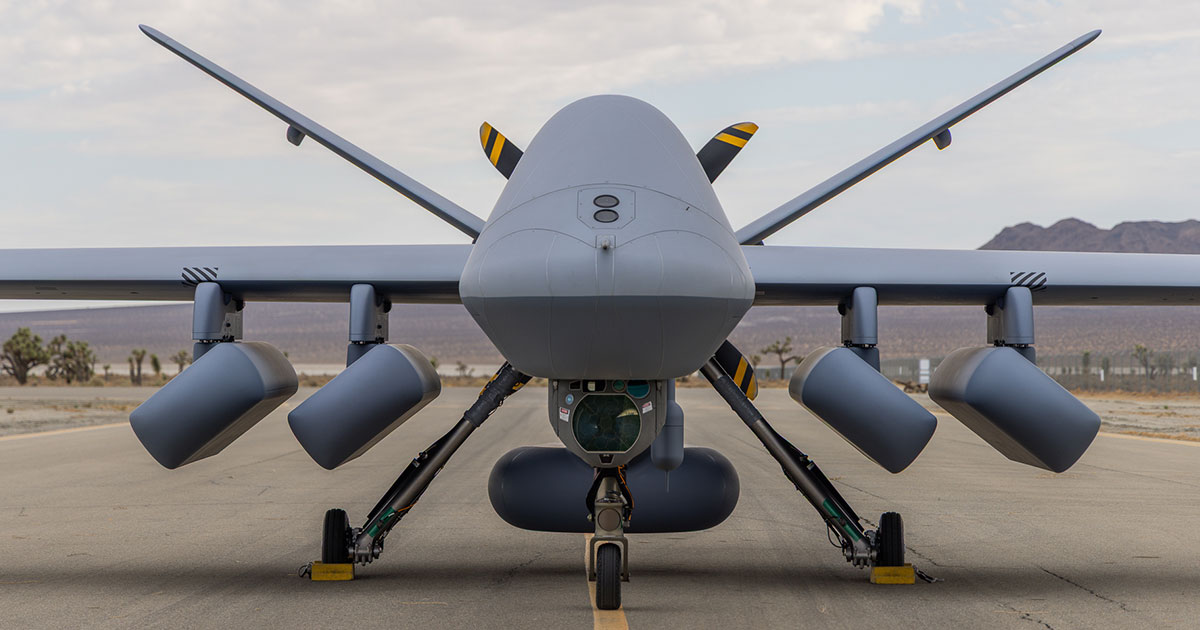
The platform that does is MQ-9B SkyGuardian®, developed by General Atomics Aeronautical Systems, Inc. The aircraft features electro-optical/infrared imaging, full-motion video, and signals intelligence (SINGINT) capabilities. The cost and time required to upgrade the NISRF fleet, including shielding to prevent sensor interference, are likely prohibitive.
With the advanced sensors and modular mission capabilities of MQ-9B, NISRF could support persistent optical and radar surveillance, maritime surface & subsurface monitoring, standoff SIGINT operations in contested airspace, airborne early warning, along with long-range targeting and weapons delivery. MQ-9B can also launch small UAS at the battlespace edge to challenge adversaries, hold them at risk or for penetrating effects.
NISRF requires this level of coverage and operational flexibility to strengthen deterrence of Russian aggression. That’s why CSBA recommends that the force acquire up to 10 multi-role uncrewed aircraft, including five MQ-9Bs.
SkyGuardian presents a great opportunity for NISRF not only because of its advanced sensors, but also because of the familiarity NATO members have with the MQ-9 series aircraft. Since the U.S. is the only member operating RQ-4 domestically, training timelines have proved challenging for the NATO RQ-4D. However, the Netherlands, France, Italy, and Spain currently operate MQ-9 systems, while the UK Royal Air Force and Belgian Air Force are operating the next-generation MQ-9B. Future deliveries of MQ-9B are on the way for Canada, Poland, Denmark, and Germany.
The CSBA study also found that increasing defense spending across NATO, purchasing 10 additional UAS, and expanding NISRF air base access would require only a very small percentage of the budget allocated to strengthening the alliance, while significantly increasing NATO ISR capabilities.
More Air Bases Proximate to Hotspots
NISRF operates out of only one field—NAS Sigonella— to cover a vast region that includes the Black Sea, the Baltic Sea, the NATO Eastern Flank, the High North, and the Greenland-United Kingdom-Iceland Gap. Although it can reach necessary ISR hot spots with its current fleet, limited sortie generation and extensive transit times stand in the way of truly persistent coverage.
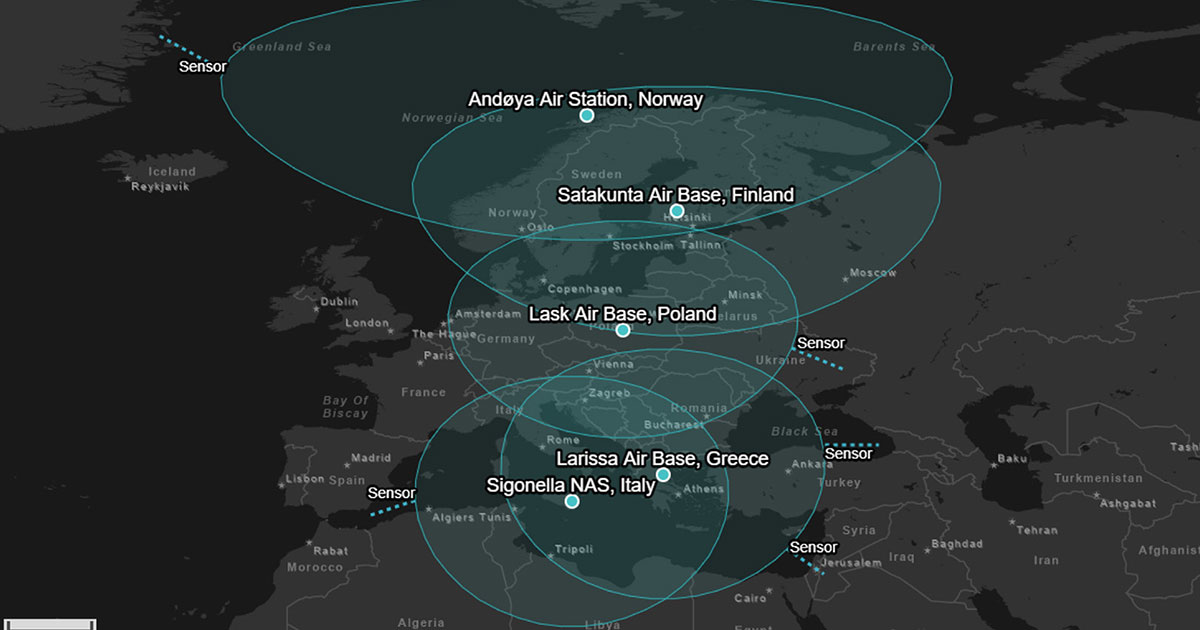
Source: Center for Strategic and Budgetary Assessments report, Diamond in the Rough: The Past, Present, and Future of NATO’s ISR Force
CSBA found that NISRF aircraft currently spend an average of 10 of their 28 mission hours transiting to and from operating areas, which accounts for roughly 35% of annual flying costs, or about $90 million in 2025. By adding four air bases to its operations—Satakunta, Łask, Larissa, and Andøya—a revised force could generate sorties within two hours of priority ISR hot spots, as assessed by the report.
However, NISRF would need the equipment and personnel to sustain operations at these bases. The report indicated this could be accomplished with larger trained forces, larger equipment stocks, and ultimately, larger budgets. NISRF could host member nation forces to support operations or use a contractor-operated model, as Poland has in the past by employing an MQ-9 for a mission, if additional NATO resources are limited. In some cases, contractor-operated UAS may be less expensive than purchasing a new system, according to the report.
The training model for MQ-9A and MQ-9B remotely piloted aircraft systems is already established. The next-gen MQ-9B offers footprint-saving features, the ability to integrate into civil airspace, as well as a short takeoff and landing capability currently in development, which will ensure operations from almost anywhere. Dispersing aircraft operations from a larger set of bases also disrupts an adversary’s targeting ability.
Real-Time Intelligence Sharing
Distributing real-time intelligence to NATO forces would be a major challenge if the alliance increases its number of ISR aircraft and bases.
Although NISRF aircraft can use Link 16, a secure system used for exchanging information between allied network participants, NATO members lack the encryption software required to receive real-time tactical data provided, the CSBA report found.
As of summer 2025, the NISRF UAS “could not exchange tactical data in flight with alliance member aircraft, whether manned or unmanned, nor could it transmit information in flight to ground-based intelligence centers other than NISRF headquarters,” per a CSBA interview with a NATO military official.
This technical gap in interoperability, and the resulting lack of a shared real-time intelligence picture between alliance members, makes it difficult to turn collected data into actionable intelligence. To succeed in credibly improving NISRF persistence and capabilities, the force must also be able to combine information from its expanded sensor suite and rapidly process, exploit, and disseminate it to allies.
Innovative intelligence and command & control software products, such as the General Atomics Quadratix enterprise, can help improve data collection and shared situational awareness. To do that, NATO must confront both the technical and policy barriers constraining force interoperability.
To anchor the NATO intelligence network and strengthen deterrence, NISRF needs to expand its fleet and sensor capabilities, increase personnel, add air bases, and must improve common intelligence sharing.