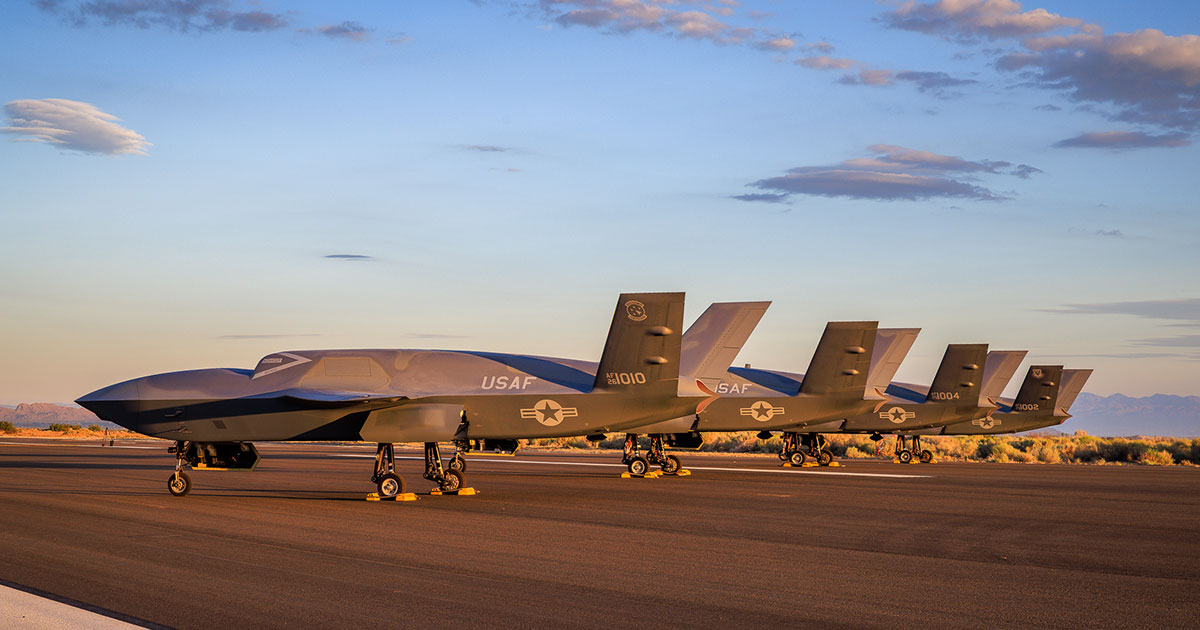
The company that introduced the world to unmanned warfare has entered a new era with an overhaul to its core lineup to confront and overmatch a new slate of high-tech threats.
Some changes at General Atomics Aeronautical Systems, Inc. (GA-ASI) have been years in the making – enhancements to its MQ-9B SkyGuardian and SeaGuardian aircraft, as well as a modernized short takeoff and landing version of the proven Gray Eagle known as Mojave.
Other changes are the result of quick action in response to urgent need.
Two new aircraft have augmented GA-ASI’s offerings with a revolutionary set of capabilities spanning the entire spectrum of conflict, from peacetime operations to full-scale combat against peer adversaries.
Recently selected by the U.S. Air Force for initial production, the FQ-42A is the world’s first uncrewed fighter jet and part of the company’s modular Gambit Series of Collaborative Combat Aircraft (CCA). This lineup focuses on low-cost air superiority aircraft built around a common design that can be produced rapidly and fielded in large numbers.
Meanwhile, the newly announced Wildfire UAS is designed as a scalable, low-cost, long-range payload delivery system – a weapons or sensor truck built to penetrate deep into enemy territory to strike targets or disrupt communications.
FQ-42A and Wildfire represent what defense officials call “attritable mass,” systems deployed in high numbers at a cost that tolerates some losses without risking human pilots or significantly degrading U.S. capability.
GA-ASI President David R. Alexander said the overhauled lineup shows the company is serious about maintaining its position as the leading UAS provider to the United States and its allies.
“We’ve never been a company that rested on its laurels,” Alexander said. “The conversation around unmanned systems has changed, and frankly, it should: The battlefield has evolved, threats have evolved and so have we. We’re keeping ahead of the game – and in the case of our Gambit Series and Wildfire, we’ve designed them from the start to overmatch today’s threats.”
A Portfolio for the Modern Fight
Critics have pointed to MQ-9A Reaper combat losses in the Middle East as evidence that the U.S. needs to break its dependency on large UAS.
Alexander doesn’t shy away from reality but reframes it.
“Yes, we’ve seen MQ-9A losses in contested environments,” he said. “But we’ve also seen Pentagon leaders call it the MVP of the campaign. That tells you something important: effectiveness matters. These systems are doing what they were designed to do and doing it better than alternatives that put pilots’ lives at risk and cost vastly more to procure, own and operate.”
The MQ-9A was purpose-built for counterinsurgency missions, Alexander explained. It was built for persistent surveillance and precision strikes in permissive airspace against non-state actors.
“The fact that Reaper continues to deliver irreplaceable capability even in contested environments speaks to just how valuable it is,” Alexander said. “It has also put urgency behind our efforts to design new aircraft that provide a lower-cost alternative for high-end conflict.”
Overview of the New
MQ-9B SkyGuardian and SeaGuardian
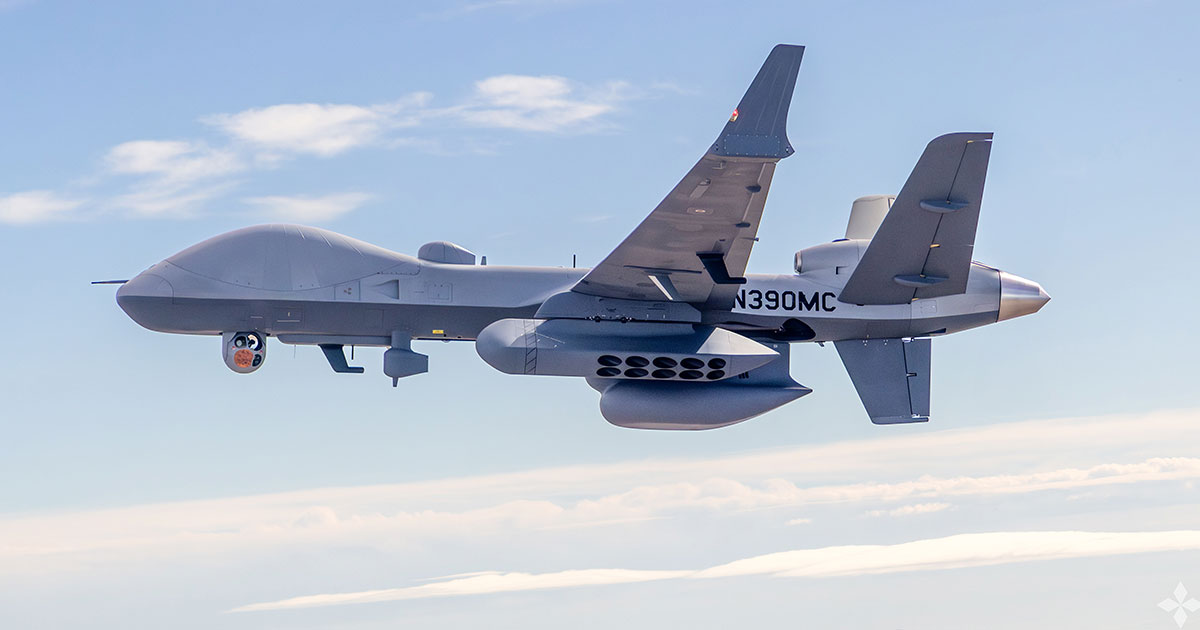
MQ-9B remains GA-ASI’s flagship multi-mission, multi-domain intelligence, surveillance and reconnaissance (ISR) aircraft. The aircraft continues to receive key upgrades securing its relevance.
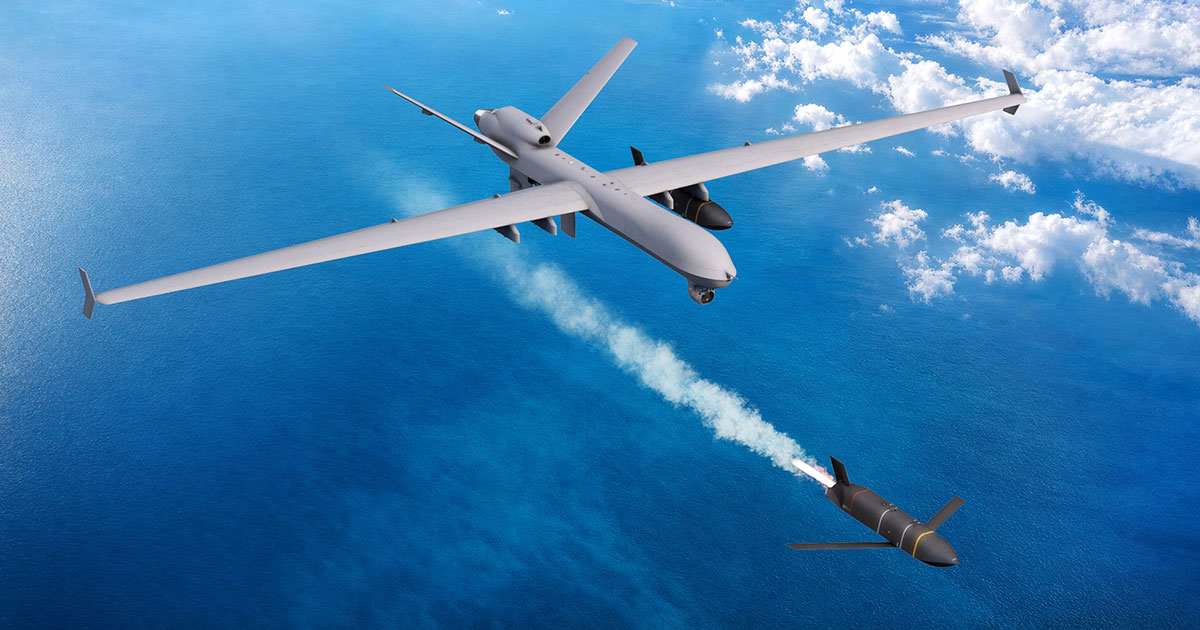
Long-Range Weapons: GA-ASI redesigned payload capacity by integrating new pylons with 30" lug spacing up from 14." This opens up longer-range payloads such as Lockheed Martin’s Long Range Anti-Ship Missile or Kongsberg’s Joint Strike Missile that, combined with MQ-9B’s ISR suite, enables the aircraft to hit targets far outside an adversary’s standoff range.
Resilient Comms: Proliferated low-earth orbit communications satellite networks add resilience to MQ-9B. By linking into these pLEO constellations, MQ-9B gains low-latency, high-bandwidth connectivity that is far harder for adversaries to jam or disrupt. Combined with DoD-standard cybersecurity architecture, MQ-9B’s new pLEO-enabled comms suite maintains secure, reliable command-and-control and sensor data links from pole to pole.
Mojave STOL
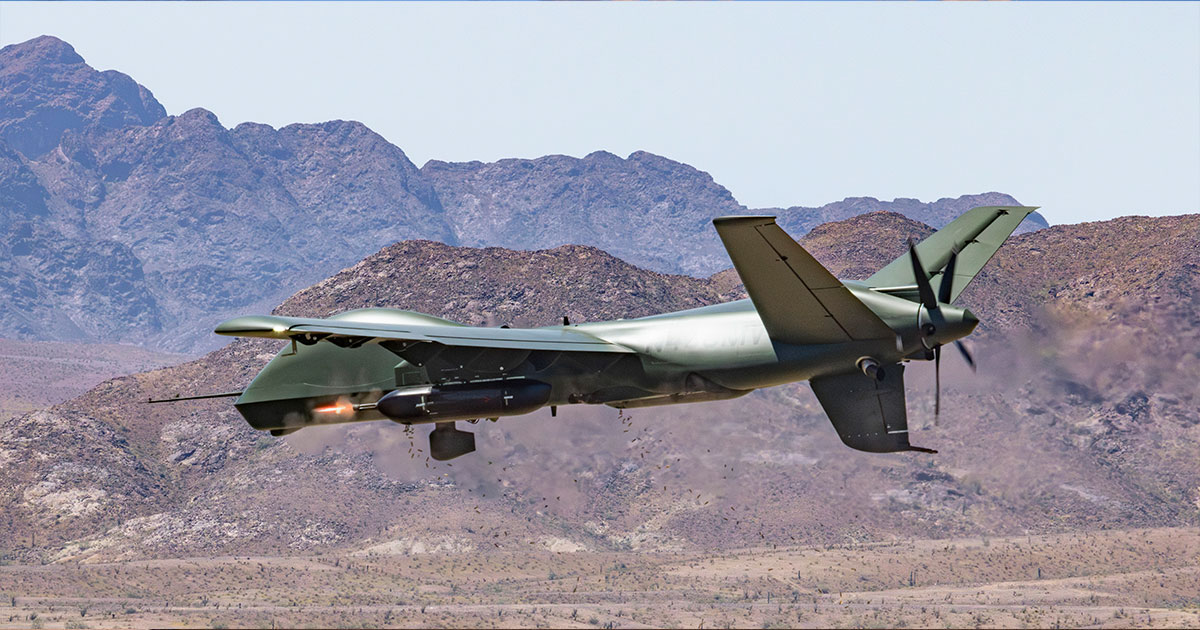
Mojave STOL builds upon the MQ-1C Gray Eagle with new features tailored to modern battlefields.
Short Takeoff & Landing: Mojave’s STOL capability enables operations from austere, unprepared locations. Unlike Gray Eagle, which requires traditional runways, Mojave STOL can use anything from an open field to a dry river bed or even the flattop deck of an amphibious assault ship as a runway, giving commanders operational flexibility in the most austere environments.
Improved Sensor Integration: Using human-portable, laptop-based ground control, Mojave STOL integrates cutting-edge sensors for ISR missions. Its advanced radar, electro-optical/infrared systems, and signals intelligence payloads provide operators with a comprehensive operational picture, enabling precise targeting and situational awareness.
Gambit Series
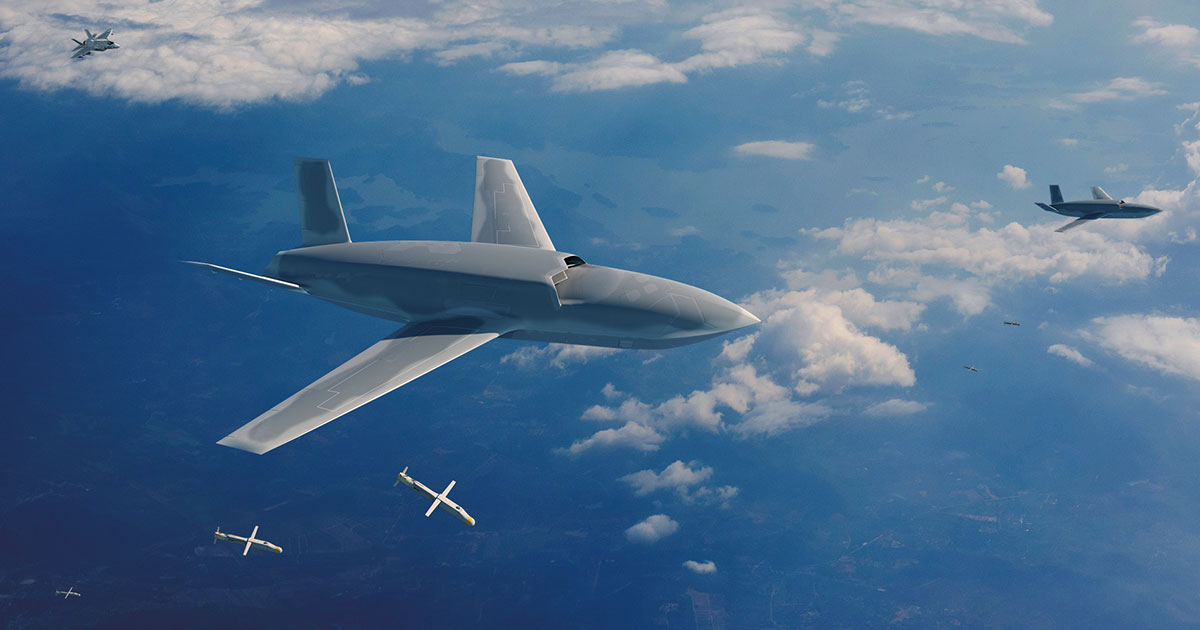
The Gambit Series is GA-ASI’s family of autonomous jet aircraft designed for high-end operations in contested airspace.
Common Core: All variants share a common, modular core (about 70 percent of key components), reducing cost and simplifying production, logistics, and sustainment.
Focused-Mission Aircraft: Gambit has six missionized variants from long-endurance ISR and air-to-air combat, to adversary training, stealth reconnaissance, carrier-based operations, and penetrating air-to-ground/SEAD.
Man-Machine Teaming: All Gambit aircraft are designed for collaborative operations, teaming with advanced fighters and other UAS to extend sensors, add weapons capacity, and impose dilemmas on adversary defenses.
Wildfire
Wildfire is GA-ASI’s theater-range, mass-producible UAS designed to deliver affordable combat mass in high-threat environments.
Range & Capability: It can carry two Long-Range Anti-Ship Missiles or four Joint Strike Missiles for meaningful combat distances, and has a ferry range that exceeds 8,000 nautical miles.
Modularity: Built around modular payload bays and open interfaces, Wildfire can rapidly shift between sensors, weapons, electronic warfare, communications relay, and other payloads, enabling commanders to adapt quickly to changing threats.
Rapid Production: Leveraging advanced manufacturing and GA-ASI’s more than five million square feet of capacity, Wildfire provides a practical path to fielding large numbers of capable aircraft that can absorb attrition while maintaining persistent, credible threat across the modern battlespace.