October 8, 2026 | UAV.com Staff Report
Militaries operating uncrewed aircraft from secure, well-maintained airbases close to the front lines look increasingly like bygone days.
As peer and near-peer adversaries deploy more capable air defenses and long-range strike systems, military planners face a straightforward challenge: how can they sustain persistent aerial reconnaissance and strike operations either from bases far from the front or from dispersed, less vulnerable locations within an enemy’s strike range?
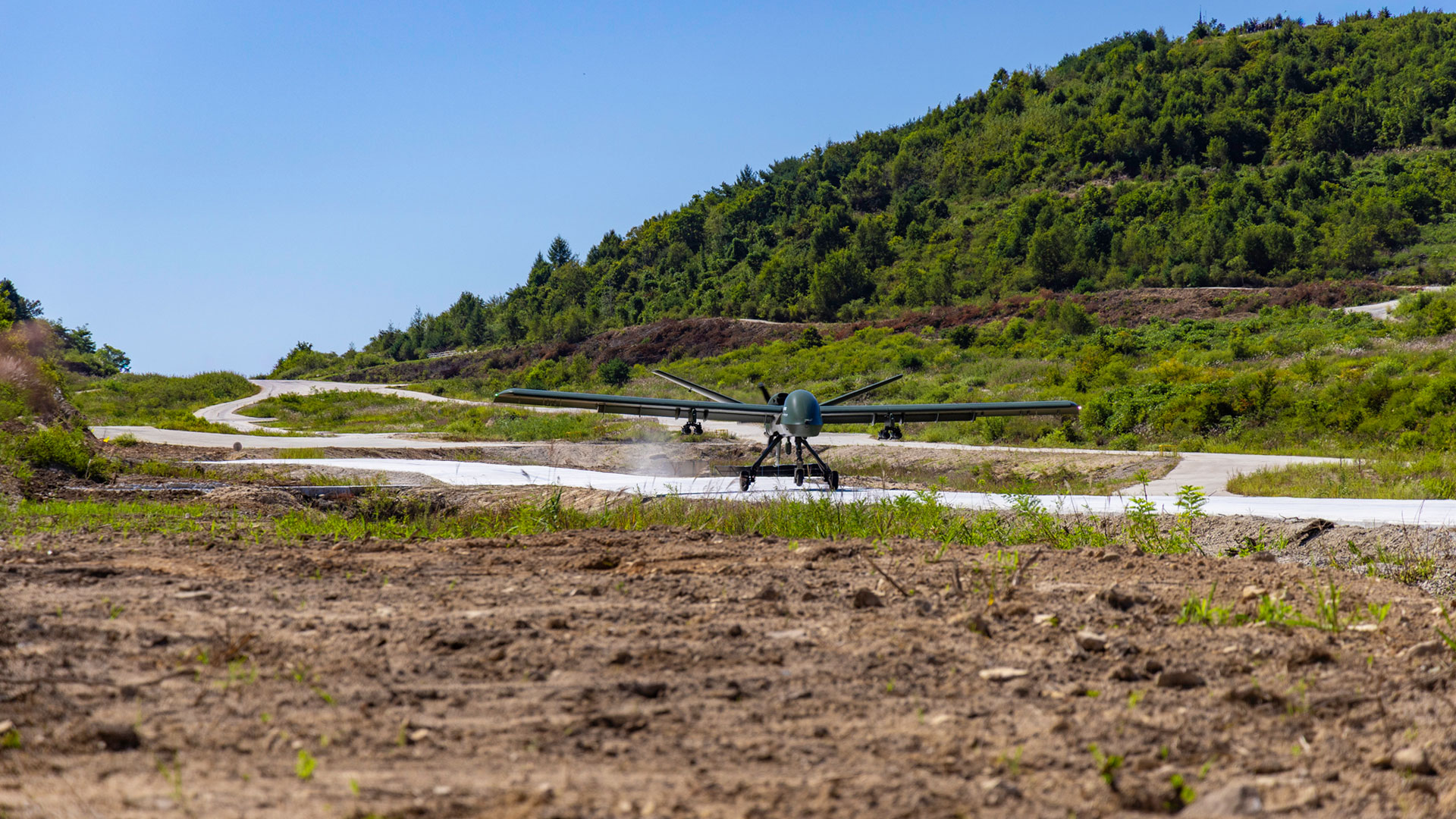
General Atomics Aeronautical Systems (GA-ASI) addresses both scenarios with two distinct aircraft under the Gray Eagle family. Mojave Short Takeoff and Landing tackles the dispersion challenge, operating from improvised locations within contested areas.
Gray Eagle 25M addresses the range problem—maintaining effectiveness while operating from distant, secure bases.
Operating Where Runways Don’t Exist
Mojave STOL is designed for the dispersion approach. It operates from unimproved surfaces such as roads, dirt tracks, or dry riverbeds, eliminating dependence on vulnerable airfield infrastructure. It can even operate from the decks of amphibious assault ships.
Commanders can position aircraft closer to distributed forces, conduct operations from austere forward locations, and relocate quickly to avoid targeting.
The aircraft leverages time-tested design rather than chasing complexity. While electric and vertical-lift concepts promise some tactical flexibility, they come with high unit costs and maintenance burdens that complicate sustained expeditionary operations.
Mojave STOL prioritizes reliability and simplicity, providing persistent mission capability with multiple sensors and weapons while operating from locations that larger, more sophisticated platforms can’t access.
Its ability to operate from naval vessels also opens possibilities for maritime operations, contested logistics, and special operations missions in environments where conventional aviation infrastructure is unavailable or undesirable.
Long-Range Operations from Secure Bases
Gray Eagle 25M represents another approach, delivering more than 40 hours of endurance in some configurations. GE 25M is an extensively modernized version of the Army’s legacy Gray Eagle aircraft for operations from more distant locations.
Key improvements to GE 25M include:
- Modular Open Systems Approach (MOSA): Defined interfaces enabling rapid integration of new sensors and capabilities without redesigning the aircraft, keeping pace with evolving threats.
- Streamlined Ground Systems: A laptop-based ground control station replaces containerized systems, cutting 130,000 pounds of equipment per platoon and enabling more mobile operations.
- Enhanced Powerplant: HFE 2.0 turbo-diesel engine extends maintenance intervals and reduces logistics footprint.
- Advanced Sensing: EagleEye multi-mode radar extends detection range up to five times over legacy systems, compensating for greater standoff distances with superior situational awareness.
Two Solutions, One Problem
The complementary nature of these platforms gives military planners options. In the Indo-Pacific, where distances are vast and airfield access is uncertain, Mojave STOL provides expeditionary flexibility while Gray Eagle 25M delivers persistent coverage from more remote bases. Both leverage an open systems architecture to evolve with mission requirements—accommodating electronic warfare systems, air-launched effects, and future capabilities as threats change.
With the GA-ASI existing manufacturing infrastructure and the partnership with Hanwha Aerospace expanding production capacity and driving down costs, both aircraft are ready to enter production today.