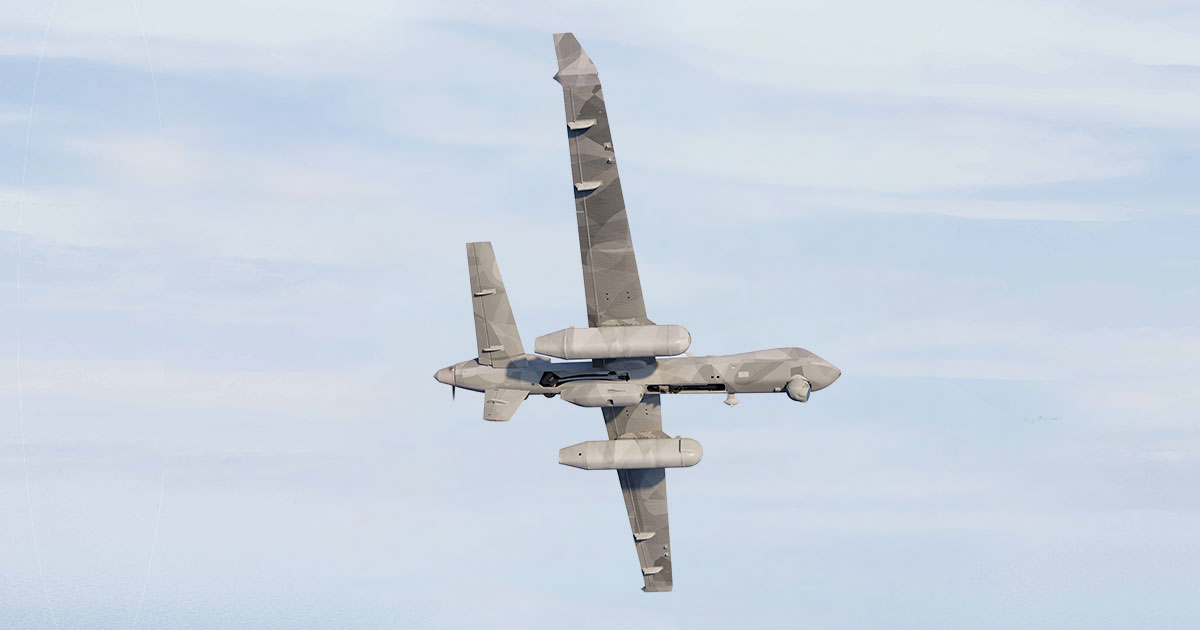
The new era of high-tech warfare is forcing the U.S. military to rethink how it does everything—even the basics. Traditionally, command & control may have been pictured as troops at headquarters adjusting pins on a paper map or marking up an operation's plot as updates came in over radio.
Today, warfare is a competition for information, fought at the speed of data.
The ability to detect adversaries, make sense of their activity, decide how to act and respond determines operational success. The modern battlespace has become more dangerous and saturated than ever. Critical early warning and C2 assets are at greater risk from one-way attack drones and missiles the closer they are to the fight or the more easily they are detected.
To this day, the U.S. Air Force relies heavily on fixed ground-based radars, radios, and data link management through Control and Reporting Centers to provide its primary air awareness picture. This is concerning, considering the sophistication of enemy strike capabilities and limited number of mobile or airborne C2 options.
In a recent article from the Mitchell Institute's Forum Papers, Lt. Col. Daniel Longstreet, U.S. Air Force argues that “the USAF must transition away from static nodes and focus on a mobile, distributed C2 grid that integrates tanker-hosted Battlefield Airborne Communications Nodes [BACN], low-cost aerial vehicles [LCAV], and mobile ground sensors to ensure tactical C2 remains survivable, adaptive, and effective in contested environments.”
C2 in the 21st century must be both air- and ground-mobile, distributed across wider areas, and include of a greater diversity and number of sensors. The modernization of the Air Force's current approach to C2 and battlespace awareness is already underway, but it is still not enough, according to Longstreet.
The E-3 Sentry Airborne Warning and Control System (AWACS) and its future replacement, E-7 Wedgetail, are critical for standoff early warning and battlespace management. But with too few aircraft available and concerns over survivability, it’s not worth the risk of operating closer to the fight. This is where additional C2 nodes are needed to provide detailed threat awareness and battlespace outcomes.
Space-based systems capable of airborne moving target indication may be on the horizon and could play a significant role in global sensing, early warning, and tactical communications across domains. However, experts from the Mitchell Institute and the Center for a New American Security caution that space C2 is still a long way off. Even if space proves as capable as some hope, it’s a mistake to overinvest in a single domain—no matter what.
In order to address near-term readiness challenges, Longstreet recommends strengthening the Air Force's overall C2 architecture with the proliferation of airborne sensing and communications nodes. In addition to provisioning BACN capabilities on airborne tankers to offset limited AWACS aircraft, he recommends using large numbers of LCAV nodes in contested airspace where the risk is too high for crewed assets.
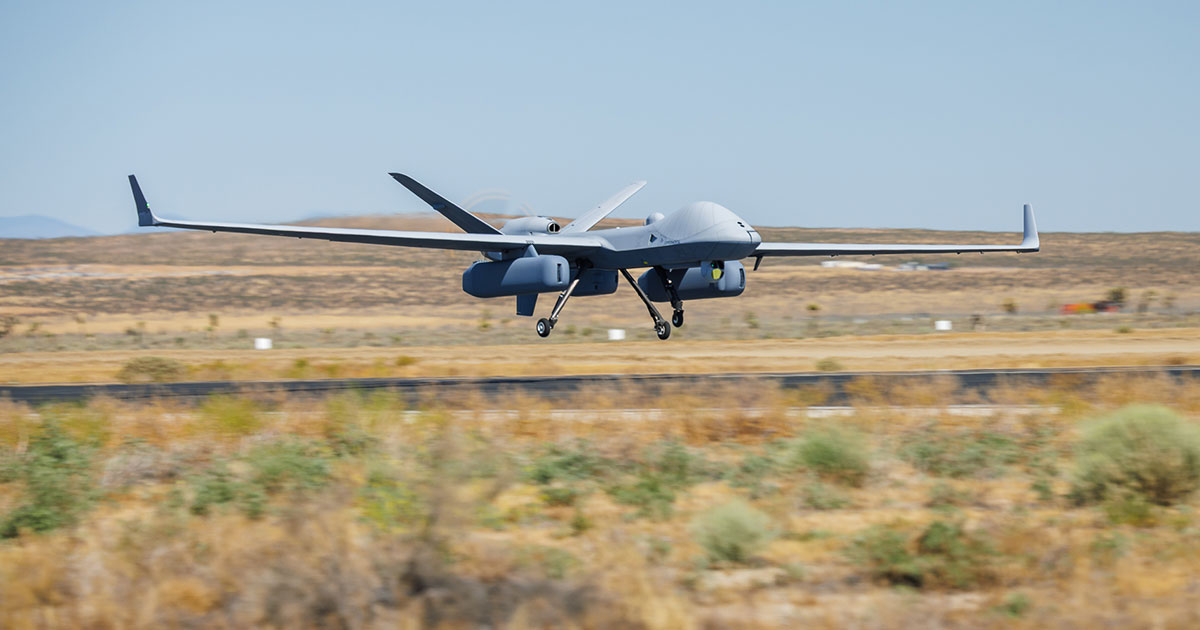
Among the lower-cost systems referenced in the Mitchell Institute article is MQ-9B SkyGuardian in an airborne early warning configuration from General Atomics Aeronautical Systems. MQ-9B costs a fraction of crewed AWACS aircraft and was designed with an open-architecture system for integrating virtually any sensing capability or communications relay the warfighter needs. Its endurance far exceeds that of crewed aircraft.
Longstreet’s paper paints a picture of a valuable LCAV system with very similar capabilities to those of MQ-9B and the Massed Modular Aircraft (MMA) requirements from the Defense Innovation Unit. The LCAV C2 nodes must be modular, with standard payload bays, common power, data harnesses, and plug-and-play sensor and communications suites.
Additional payloads and internal systems affect cost, but there is a need for active electronically scanned array radars for air and surface search; ground/dismount moving target indication for low-flying UAVs and ground vehicles; electro-optical and infrared sensors for target identification; and BACN-like communications modules that extend a mesh C2 network into contested airspace.
MQ-9B has already proven use of these systems and is capable of more, all at a favorable cost per aircraft. Because of the system’s flexible architecture, options are available to narrow the scope of the sensor suite to scale cost and capability. MMAs could also focus on a specific autonomous mesh network capability while enabling the delivery of munitions en masse.
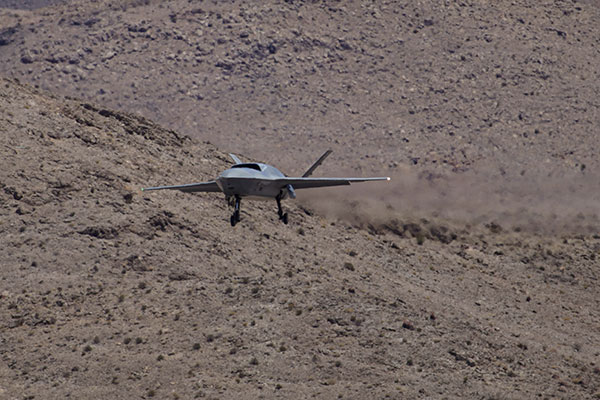
Key requirements that Longstreet and other experts also agree on are mass scalability and autonomy for tactical C2. This doesn’t single out any specific solution. MMA and collaborative combat aircraft are meant to generate affordable mass alongside crewed platforms and engage enemy targets autonomously. Tactical uncrewed C2 meeting these requirements is likely a mix of medium-altitude, long-endurance UAVs, MMAs, and CCAs working together autonomously at different scales and threat ranges.
Connecting with E-3s and BACN-enabled tankers operating out of enemy range, several stand-in MQ-9Bs on the edge could provide critical battlespace awareness and C2 relay capabilities for a large mesh network of autonomous MMAs and CCAs further forward. Commands would flow from officers, air or ground stations, back through the mesh network to enable the joint force to see and act well ahead of its adversary.
Assisted by a range of satellite, line-of-site, and other communication pathways, this arrangement could provide the resilient, tactical C2 and battlespace awareness the U.S. Air Force needs to stay ahead.
In any near-peer fight, aircraft will be lost. It can’t be avoided. The Air Force can choose to employ large numbers of proven cost-effective systems to help connect the warfighter and technology assets, expand battlespace awareness, and deliver valuable tactical effects before taking fire—without endangering the lives of pilots or aircrews on a very dangerous mission.